
 简体中文
简体中文 Shqip
Shqip لالعربية
 Polski
 رسی
رسی Deutsch
 Русский
 Français
 한국어
한국어 Nederlands
 Čeština
 Bahasa Melayu
 Português
 日本語
日本語 Svenska
 Kiswahili
 ไทย
ไทย Türkçe
 繁体中文
繁体中文 Українська
 Español
 Italiano
 हिन्दी
 Bahasa Indonesia
 Tiếng Việt
 Filipino
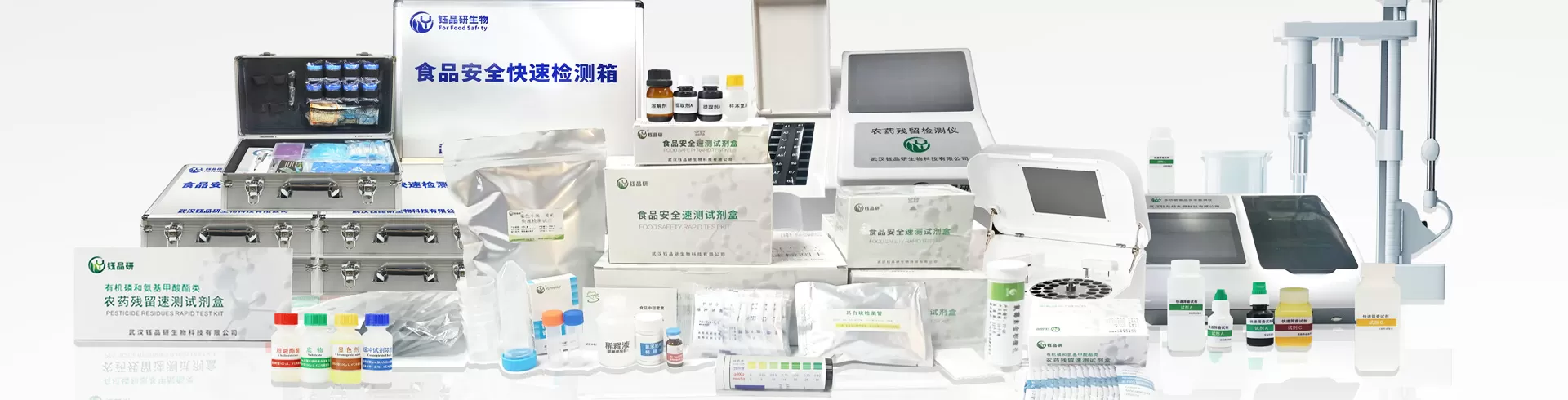
In the grass-roots food safety law enforcement work, fast and accurate on-site detection is the key link to timely investigation of risks and protection of public dietary safety. Colloidal gold card has become an important tool for the personal flow detection of grass-roots law enforcement due to its strong portability, fast detection speed and easy operation. The colloidal gold rapid detection reagent produced by our company (Wuhan Yupinyan Biological) can carry out on-site screening for common food contaminants, additives, microorganisms and other indicators through optimized immunochromatography technology, providing strong technical support for law enforcement work.

the core advantages of colloidal gold card on-site testing
Compared with traditional laboratory testing, colloidal gold card on-site testing has significant advantages: First, the detection efficiency is high, from sample processing to result interpretation usually only takes 10-15 minutes, which can meet the needs of law enforcement on-site "rapid screening and instant decision-making"; Second, the operation threshold is low, no professional equipment and complex training are required, and grass-roots law enforcement personnel can complete it independently after simple training; Third, the portability is outstanding, and the detection card is small and lightweight, which is convenient for law enforcement personnel to carry to the market, catering units and other sites to carry out mobile testing; Fourth, the cost is controllable, and the cost of single sample testing is low, which is suitable for large-scale screening scenarios.
the standard process of on-site operation
colloidal gold card on-site operation needs to strictly follow the standardized process The first is the preparation work. It is necessary to check in advance whether the valid period of the test card, the type of sample and the test item match, and prepare the sampling tools (such as cotton swabs, centrifuge tubes), droppers, timers and other items. Secondly, the sample is processed. According to the shape of the test object (such as vegetables, meat, dairy products, edible oil, etc.), representative samples are collected according to the instructions: the liquid sample can be directly absorbed; the solid sample needs to be ground and diluted with buffer to ensure the extraction of active ingredients.
Sampling addition is the key. The processed sample is slowly dripped along the test card addition hole (or precisely added with a pipette). Pay attention to avoid spillage or leakage. The amount of sample addition should be strictly controlled within the range specified in the instructions. After adding the sample, place the test card flat on the horizontal table, start the timer, and let it stand until the specified time (usually 10-15 minutes), during which time to avoid direct sunlight or violent shaking.
During the result interpretation stage, it is necessary to observe the color development of the quality control line (C line) and the test line (T line) on the test card within the specified time: if the C line is clearly colored, the T line is not colored or the color is lighter than the C line, it is determined to be negative (the sample does not detect the target substance); if both the C line and the T line are colored, it is determined to be positive (the sample contains the target substance); if the C line does not develop color, whether the T line is colored or not, it is an invalid result and needs to be re-tested.
result evidence collection and compliance guarantee
test results need to be recorded and retained to provide a basis for subsequent law enforcement processing. On-site photos of the test card need to be taken with clear light to ensure that the C-line and T-line color details are complete, and the shooting time, sample number and other information are marked. At the same time, the test record form needs to be filled in in detail, indicating the source of the sample, the test item, the operator and the result judgment, and signed and confirmed by the law enforcement personnel.
For positive result samples, the samples need to be sealed and retained as required, and properly stored until the laboratory for review; negative result samples can be processed according to the on-site management requirements. All operation records and photos need to be archived to ensure that the entire testing process can be traced back and meet the evidence standards of food safety law enforcement work.
colloidal gold card, as a practical tool for grassroots law enforcement flow testing, plays an important role in improving the efficiency of food safety supervision. Our company has always been committed to developing high-quality rapid detection reagents to help grassroots law enforcement officers quickly identify risks and protect the "safety on the tip of the tongue" of the masses.


