简体中文
简体中文 Shqip
Shqip لالعربية
 Polski
 رسی
رسی Deutsch
 Русский
 Français
 한국어
한국어 Nederlands
 Čeština
 Bahasa Melayu
 Português
 日本語
日本語 Svenska
 Kiswahili
 ไทย
ไทย Türkçe
 繁体中文
繁体中文 Українська
 Español
 Italiano
 हिन्दी
 Bahasa Indonesia
 Tiếng Việt
 Filipino
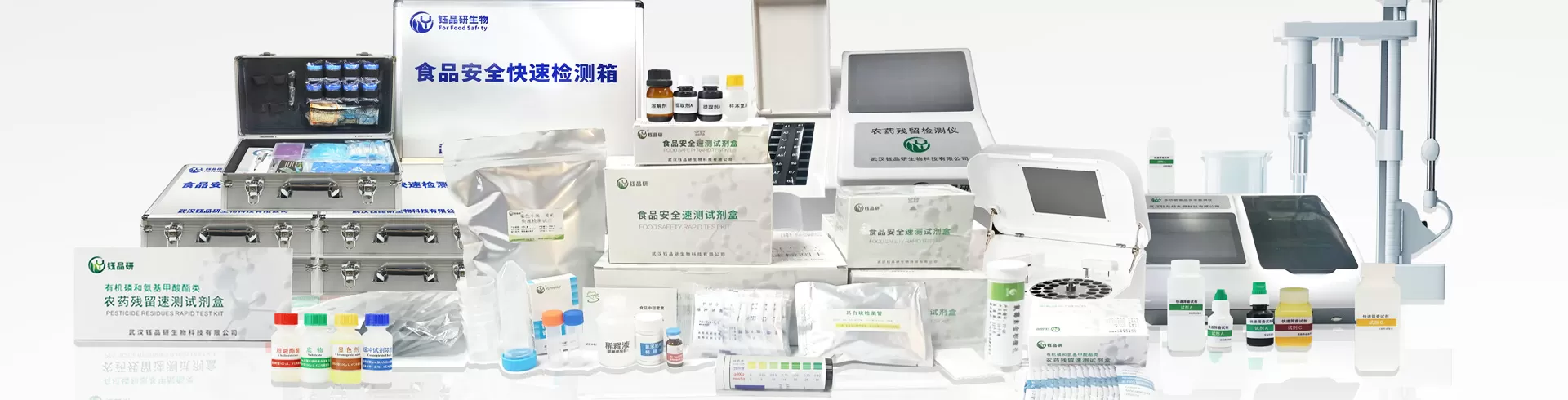
Triazophos is an organophosphorus insecticide, which is widely used in agricultural production to control a variety of pests. Because it may remain in agricultural products and pose latent risks to human health, accurate detection of its residue is essential to ensure food safety. Detection limit, as a core indicator to measure the sensitivity of detection methods, directly affects the reliability of detection results and the choice of application scenarios. This paper will focus on the basic concept of triazophos detection limit, as well as the differences in detection limits of three commonly used detection methods: colloidal gold, liquid and gas phase.
Basic concept of triazophos detection limit
Detection limit (LOD) refers to the detection method that can reliably identify and quantify the minimum concentration of the target substance in a specific substrate. For triazophos residues in food, the detection limit is affected by factors such as the sample substrate (such as vegetables, fruits, grains, etc.), the principle of detection methods and standard requirements. Usually, the detection limit of triazophos in agricultural products ranges from a few ng/g to tens of ng/g, and the specific value needs to be determined in combination with the detection standard and the characteristics of the target substrate. For example, if the rapid detection of colloidal gold is used to screen for triazophos in vegetables, the detection limit may be relatively high, but when the laboratory adopts liquid-mass spectrometry technology, the detection limit can be significantly reduced.
Difference in detection limits of different detection methods
Colloidal gold detection method
Colloidal gold detection method is a common technology for on-site rapid screening. With its advantages of simple operation, short detection time, and no need for complex instruments, it is widely used in scenes such as primary supervision and enterprise self-testing. This method realizes qualitative or semi-quantitative detection of target substances through specific binding reaction of antigens and antibodies. Its detection limit is usually between 10 ng/g and 50 ng/g, which is suitable for preliminary screening of samples with high triazophos residues. However, trace residues (such as concentrations below 10 ng/g) may not be accurately identified, making it difficult to meet the needs of accurate quantification.
Liquid chromatography-mass spectrometry (liquid) detection method
Liquid-mass spectrometry technology combines the high-performance separation ability of liquid chromatography with the high selectivity and high sensitivity of mass spectrometry, which can effectively eliminate matrix interference and accurately identify triazophos and its metabolites. By optimizing the chromatographic column, mobile phase system and mass spectrometry parameters (such as ion source type, scanning mode, etc.), the detection limit of liquid-mass spectrometry can be significantly reduced to 0.1 ng/g or even lower. This method can not only meet the quantitative detection needs of low-residue samples, but also provide a confirmation basis for trace contaminants in complex matrices. It is one of the core technologies for high-sensitivity detection in laboratories.
Gas chromatography (gas phase) detection method
Gas chromatography usually requires a special detector such as an electron capture detector (EPS) or a nitrogen and phosphorus detector (NPD) to use the volatility and thermal stability of organophosphorus compounds to achieve separation and detection. After optimizing the chromatographic conditions (such as column temperature, carrier gas flow rate) and pretreatment methods (such as derivatization, purification), the detection limit of gas chromatography can generally reach about 1 ng/g, which can meet the quantitative analysis requirements of triazophos residues in most agricultural product matrices. However, this method requires high purification of the sample matrix, and the derivatization process may introduce additional errors. The operation is relatively complicated, and it is more suitable for routine laboratory detection scenarios.
Wuhan Yupinyan Bio focuses on the research and development and production of food safety rapid detection reagents. We know the importance of detection limits for food safety supervision. Whether it is colloidal gold rapid detection reagents or matching reagents required for liquid and gas phase detection, we are committed to improving the sensitivity and accuracy of detection through technical optimization, providing efficient and reliable detection solutions for food production enterprises, regulatory authorities and scientific research institutions, and helping to build a food safety defense line from farmland to table.