简体中文
简体中文 Shqip
Shqip لالعربية
 Polski
 رسی
رسی Deutsch
 Русский
 Français
 한국어
한국어 Nederlands
 Čeština
 Bahasa Melayu
 Português
 日本語
日本語 Svenska
 Kiswahili
 ไทย
ไทย Türkçe
 繁体中文
繁体中文 Українська
 Español
 Italiano
 हिन्दी
 Bahasa Indonesia
 Tiếng Việt
 Filipino
As a broad-spectrum organophosphorus insecticide, triazophos is widely used in agricultural production to control a variety of crop pests. However, its residues may pose a potential threat to the quality and safety of agricultural products and human health, so it is crucial to establish accurate and efficient detection methods. At present, the detection of triazophos mainly includes colloidal gold rapid detection, gas chromatography (GC) and liquid-mass spectrometry (LC-MS/MS). Different methods have different focuses on detection efficiency, accuracy and applicable scenarios.
colloidal gold rapid detection method: the first choice for convenient screening
colloidal gold rapid detection method is based on the principle of immunochromatography. It forms a color-developing strip on the test strip through the specific binding reaction of colloidal gold-labeled antibodies and triazophos antigens. The method does not require complex equipment, is easy to operate, and usually produces results in 10-20 minutes. It is suitable for rapid on-site screening or large-scale sample initial screening. Its core advantages are low cost, high speed, and can be operated without professional technicians. It is especially suitable for rapid judgment in primary detection scenarios or emergency situations. However, colloidal gold methods are mostly qualitative or semi-quantitative detection, with limited sensitivity to low-concentration residues, and cannot provide specific quantitative data. They are more suitable for preliminary screening of suspicious samples.
gas chromatography: a reliable choice for classical quantification
gas chromatography uses the difference in the partition coefficient of triazophos in the gas phase to achieve separation and quantification. It usually needs to be combined with an electron capture detector (EPS) or a nitrogen and phosphorus detector (NPD) to improve the detection sensitivity. This method converts the target into the gas phase state through sample pretreatment (such as extraction, purification, concentration), and then separates it by a chromatographic column for quantitative analysis. The advantage of gas chromatography is that the separation effect is good, the quantification is accurate, the detection limit of ppm level or even ppb level can be achieved, and the reproducibility is high, which is suitable for routine laboratory detection. However, this method requires professional equipment and a long pretreatment time, requires high technical level of the operator, and the overall detection cycle is long (usually 1-2 hours), which is more suitable for laboratory scenarios with high detection accuracy and small sample size.
Liquid-mass spectrometry technology: a technical benchmark for accurate qualitative quantification
Liquid-mass spectrometry technology combines the separation ability of liquid chromatography and the qualitative ability of mass spectrometry. After separating triazophos and its metabolites by high-performance liquid chromatography, the mass spectrometry detector realizes accurate qualitative and quantitative. This method does not require complicated pretreatment steps, and can directly detect triazophos in complex matrix samples (such as soil and agricultural products). It has extremely high sensitivity (up to pg level) and specificity, especially suitable for confirmation detection of low-concentration residues. Liquid-mass spectrometry technology can also analyze multiple targets at the same time, and is currently one of the mainstream technologies in the field of food safety testing. However, its core shortcomings lie in the high cost of instrument purchase and maintenance, the need for professional operation and data analytics teams, and the detection cycle is relatively long (usually 30-60 minutes). It is more suitable for large laboratories or scientific research scenarios that require accurate data.
selection strategy of triazophos detection method
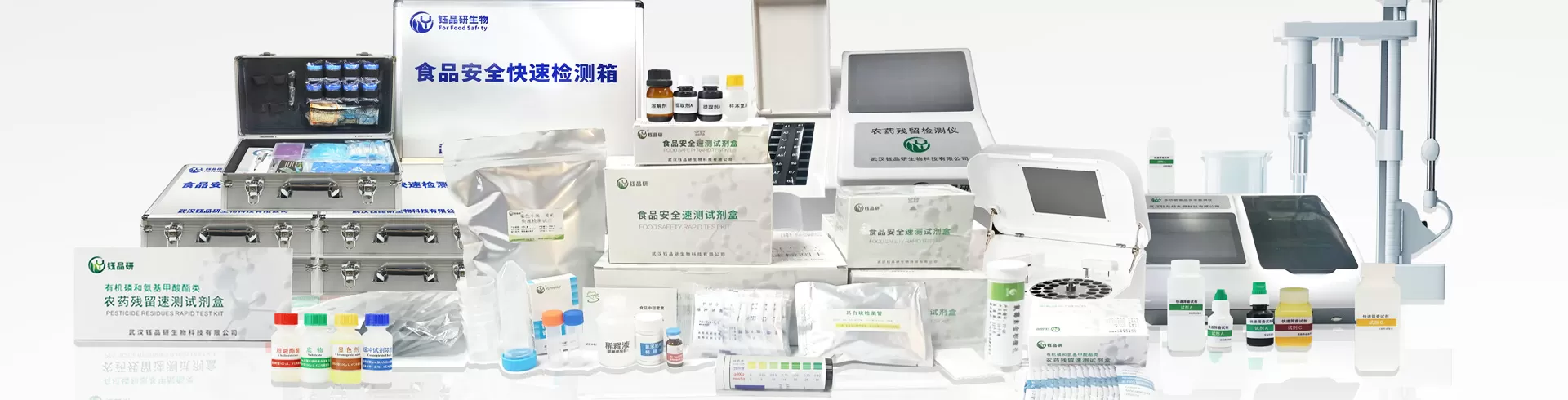
when selecting triazophos detection method, it is necessary to comprehensively consider the detection needs, sample types and actual scenarios: if rapid screening is required (such as farmers market, field rapid sampling), colloidal gold rapid detection method is preferred, and the colloidal gold detection reagent of Wuhan Yupinyan Bio can meet the needs of on-site screening. The operation is simple and the results are intuitive; if it is a routine quantitative detection in the laboratory, gas chromatography with mature separation and quantitative technology is still a reliable choice; if it involves complex substrates or requires low concentration residue confirmation, liquid-mass spectrometry technology can provide accurate data support. In addition, different methods can be used in combination, such as screening positive samples with colloidal gold method first, and then quantitative confirmation by gas chromatography or liquid-mass spectrometry to form a complete detection plan.
No matter which method is used, ensuring the accuracy and reliability of test results is the core goal. Wuhan Yupinyan Bio focuses on the research and development of food safety rapid detection reagents, and is committed to providing efficient and accurate detection solutions for various scenarios through technological innovation to help build a strong food safety defense line.