简体中文
简体中文 Shqip
Shqip لالعربية
 Polski
 رسی
رسی Deutsch
 Русский
 Français
 한국어
한국어 Nederlands
 Čeština
 Bahasa Melayu
 Português
 日本語
日本語 Svenska
 Kiswahili
 ไทย
ไทย Türkçe
 繁体中文
繁体中文 Українська
 Español
 Italiano
 हिन्दी
 Bahasa Indonesia
 Tiếng Việt
 Filipino
As an organophosphorus insecticide, triazophos is widely used in agricultural production, which has a significant effect on the control of cotton bollworm, cabbage green insect and other pests. However, with the increase of use, the residue problem in agricultural products has gradually become prominent, which may not only affect the quality of agricultural products, but also pose a potential threat to human health. Therefore, the establishment of a scientific and effective triazophos detection system forms a complete logical chain from residue detection to health threat and risk assessment, which has become a key link in ensuring food safety.
potential harm and residue status of triazophos
The residue of triazophos mainly comes from the excessive application of pesticides in the planting process of agricultural products, and the harvest and listing of agricultural products before the safety interval is reached after application. When the human body ingests food containing residual triazophos, it may cause acute poisoning symptoms, such as nausea, vomiting, dizziness, breathing difficulties, etc. Long-term low-dose intake may also cause chronic damage to the nervous system and endocrine system, and even increase the risk of carcinogenesis. At present, our country and the world have gradually clarified the residue standards of triazophos in agricultural products, but the actual detection still needs to face complex matrix interference and trace residue problems, and efficient detection technology is urgently needed.
the key technical path of triazophos residue detection
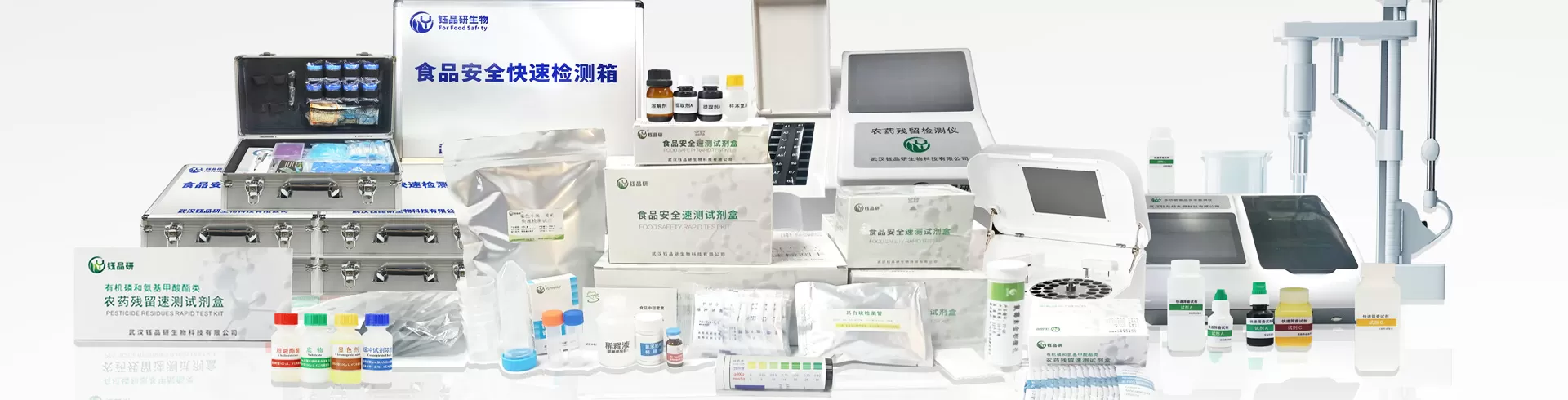
triazophos residue detection technology can be divided into two categories: laboratory precision detection and on-site rapid screening. Laboratory methods such as high performance liquid chromatography-mass spectrometry (HPLC-MS/MS) and gas chromatography-electron capture detector (GC-EPS) are commonly used for laboratory testing. These techniques have high resolution and high sensitivity, and can accurately quantify ppb-level residues. They are suitable for arbitration detection and research analysis. In the actual production and distribution, the demand for rapid detection technology is more urgent - Wuhan Yupinyan Biological's food safety rapid detection reagent, with its high specificity and high sensitivity, can complete the preliminary screening and quantitative analysis of triazophos residues in samples in a short time. It is easy to operate and does not require complex equipment. It can be widely used in scenarios such as grassroots supervision, enterprise self-inspection and market sampling, providing a strong guarantee for the rapid identification of excessive samples.
the logical relationship between health threat and risk assessment and residue detection
residue detection results are the core data source for health threat and risk assessment. Through the systematic detection of triazophos residues in different places and crops, combined with the calculation of consumer dietary exposure (such as daily average intake, consumption frequency, etc.), and the toxicity database of triazophos (such as LD50, chronic toxicity threshold, etc.), health threat and risk assessment models can be constructed. For example, if the detection shows that the triazophos residue in a certain type of vegetable exceeds the national standard limit, combined with the exposure data of the population who eats the vegetable for a long time, the carcinogenic risk level can be evaluated, and then the development of targeted control measures can be guided, such as adjusting the application specification, shortening the safety interval, or restricting the marketing volume. This closed-loop logic of "detection-evaluation-control" can effectively control the hazard of triazophos residues within an acceptable range and protect the public's dietary safety.
Accurate triazophos residue detection is the premise of assessing its health risks, while scientific health threat and risk assessment provides the basis for formulating stricter safety control strategies. Wuhan Yupinyan Bio has always been committed to the research and development and application of food safety rapid detection technology. By providing reliable rapid detection reagents, it helps the industry control triazophos residues from the source and contributes to the construction of a full-chain food safety assurance system.