
 简体中文
简体中文 Shqip
Shqip لالعربية
 Polski
 رسی
رسی Deutsch
 Русский
 Français
 한국어
한국어 Nederlands
 Čeština
 Bahasa Melayu
 Português
 日本語
日本語 Svenska
 Kiswahili
 ไทย
ไทย Türkçe
 繁体中文
繁体中文 Українська
 Español
 Italiano
 हिन्दी
 Bahasa Indonesia
 Tiếng Việt
 Filipino
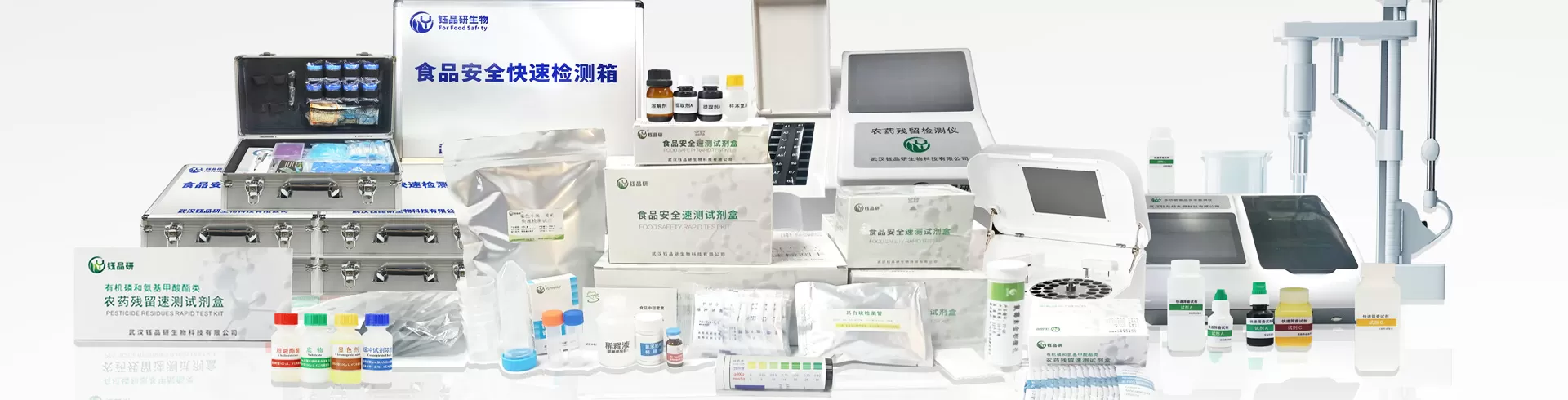
In the field of food safety testing, accurate identification of pesticide residues in agricultural products is a key link to protect consumer health. Imidacloprid, as a common insecticide, is closely related to public dietary safety in its residue detection, while bananas, as a high-consumption fruit, attract more attention to the issue of pesticide residues. Wuhan Yupinyan Bio focuses on the research and development of food safety rapid detection reagents to help solve the need for efficient screening in pesticide residue detection.
First of all, what is imidacloprid? It is a neonicotinoid insecticide. It has a high-efficiency insecticidal effect through acetylcholine receptors acting on the nervous system of insects. It is widely used in the pest control of bananas, vegetables and other crops. Although it can effectively reduce crop losses, excessive or improper use may lead to residues. Therefore, the detection of its residues has become an important part
For the detection of banana pesticide residues, although traditional methods such as gas chromatography and liquid chromatography can accurately quantify, the equipment is complex and time-consuming, making it difficult to meet the needs of on-site rapid screening. In contrast, the rapid detection technology of colloidal gold immunochromatography has become an ideal choice for the detection of banana pesticide residues due to its advantages of simple operation, short detection time (10-15 minutes for results) and low cost. This technology realizes rapid qualitative or semi-quantitative detection of residual components in the sample through the immune reaction of specific antibodies and target substances, combined with the color rendering characteristics of colloidal gold particles.
Full analysis of colloidal gold detection card: its core principle is based on the specific binding of antigen-antibody and the tracer effect of colloidal gold. The detection card structure usually includes a sample pad, a binding pad (pre-coated colloidal gold-labeled antibody), a reaction film (coated detection line and quality control line), and a water-absorbing pad. During testing, the treated banana sample liquid is dropped into the sample hole, and the liquid flows through each area in turn: if there is imidacloprid in the sample, it will compete with the colloidal gold-labeled antibody on the binding pad to bind the detection line antibody on the reaction film, resulting in the detection line not showing color; if there is no residue, the labeled antibody binds to the detection line antibody, and the detection line develops color. At the same time, the quality control line develops color due to the non-specific binding of the labeled antibody, indicating that the detection is valid. If the quality control line does not develop color, the detection is invalid and needs to be re-operated.
The colloidal gold test card produced by Wuhan Yupinyan Bio strictly follows the Quality Standard to ensure that the test results are stable and reliable.


